Engraving 1888 a Corner in Westminster Abbey Art Supplement to the Churchman
| Lewis Carroll | |
|---|---|
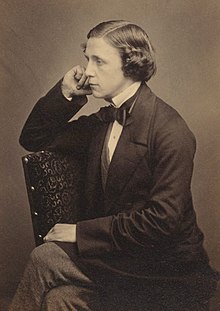 Carroll in June 1857 | |
| Born | Charles Lutwidge Dodgson (1832-01-27)27 Jan 1832 Daresbury, Cheshire, England |
| Died | xiv Jan 1898(1898-01-xiv) (anile 65) Guildford, Surrey, England |
| Occupation |
|
| Educational activity |
|
| Genre |
|
| Relatives |
|
| Signature | ![C. L. Dodgson [alias "Lewis Carroll"]](https://upload.wikimedia.org/wikipedia/commons/thumb/8/83/LewisCarrollAutograph_vector.svg/160px-LewisCarrollAutograph_vector.svg.png) |
Charles Lutwidge Dodgson (; 27 January 1832 – 14 January 1898), better known by his pen proper noun Lewis Carroll, was an English author, poet and mathematician. His nearly notable works are Alice's Adventures in Wonderland (1865) and its sequel Through the Looking-Glass (1871). He was noted for his facility with word play, logic, and fantasy. His poems Jabberwocky (1871) and The Hunting of the Snark (1876) are classified in the genre of literary nonsense.
Carroll came from a family unit of high-church Anglicans, and developed a long human relationship with Christ Church, Oxford, where he lived for most of his life equally a scholar and teacher. Alice Liddell, the girl of Christ Church's dean Henry Liddell, is widely identified as the original inspiration for Alice in Wonderland, though Carroll always denied this.
An avid puzzler, Carroll created the word ladder puzzle (which he then called "Doublets"), which were published in his weekly column for Vanity Off-white magazine between 1879 and 1881. In 1982, a memorial stone to Carroll was unveiled at Poets' Corner in Westminster Abbey. There are societies in many parts of the globe dedicated to the enjoyment and promotion of his works.[ane] [ii]
Early life [edit]
Dodgson'southward family unit was predominantly northern English, bourgeois, and loftier-church building Anglican. Most of his male ancestors were ground forces officers or Anglican clergymen. His nifty-grandfather, Charles Dodgson, had risen through the ranks of the church to go the Bishop of Elphin in rural Ireland.[3] His paternal grandfather, another Charles, had been an army captain, killed in action in Republic of ireland in 1803, when his two sons were inappreciably more than than babies.[4] The older of these sons, even so another Charles Dodgson, was Carroll's father. He went to Westminster School and and then to Christ Church, Oxford. He reverted to the other family tradition and took holy orders. He was mathematically gifted and won a double beginning degree, which could have been the prelude to a brilliant academic career. Instead, he married his outset cousin Frances Jane Lutwidge in 1830 and became a country parson.[5] [6]
Dodgson was built-in on 27 January 1832 at All Saints' Vicarage in Daresbury, Cheshire,[7] the oldest male child and the tertiary oldest of 11 children. When he was eleven, his male parent was given the living of Croft-on-Tees, Yorkshire, and the whole family moved to the spacious rectory. This remained their home for the next 25 years. Charles' male parent was an agile and highly conservative cleric of the Church of England who later became the Archdeacon of Richmond[8] and involved himself, sometimes influentially, in the intense religious disputes that were dividing the church. He was loftier-church building, inclining toward Anglo-Catholicism, an admirer of John Henry Newman and the Tractarian motion, and did his best to instil such views in his children. Notwithstanding, Charles developed an clashing relationship with his father's values and with the Church of England every bit a whole.[nine]
During his early youth, Dodgson was educated at home. His "reading lists" preserved in the family athenaeum bear witness to a precocious intellect: at the historic period of seven, he was reading books such as The Pilgrim's Progress. He also spoke with a stammer – a condition shared by most of his siblings[x] – that often inhibited his social life throughout his years. At the age of twelve he was sent to Richmond Grammar School (now part of Richmond School) in Richmond, North Yorkshire.
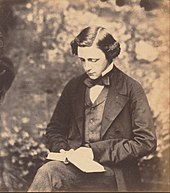
Lewis Carroll cocky-portrait c. 1856, aged 24 at that fourth dimension
In 1846, Dodgson entered Rugby School, where he was obviously unhappy, every bit he wrote some years later on leaving: "I cannot say ... that any earthly considerations would induce me to go through my three years once more ... I tin can honestly say that if I could take been ... secure from annoyance at nighttime, the hardships of the daily life would accept been comparative trifles to comport."[xi] He did non claim he suffered from bullying, just cited piffling boys every bit the primary targets of older bullies at Rugby.[12] Stuart Dodgson Collingwood, Dodgson's nephew, wrote that "even though it is difficult for those who have just known him as the gentle and retiring don to believe it, information technology is still true that long after he left schoolhouse, his proper noun was remembered as that of a male child who knew well how to use his fists in defense force of a righteous crusade", which is the protection of the smaller boys.[12]
Scholastically, though, he excelled with apparent ease. "I have not had a more promising boy at his historic period since I came to Rugby", observed mathematics primary R. B. Mayor.[13] Francis Walkingame's The Tutor's Banana; Being a Compendium of Arithmetic – the mathematics textbook that the immature Dodgson used – still survives and it independent an inscription in Latin, which translates to: "This volume belongs to Charles Lutwidge Dodgson: hands off!"[fourteen] Some pages also included annotations such equally the one constitute on p. 129, where he wrote "Non a fair question in decimals" next to a question.[xv]
He left Rugby at the cease of 1849 and matriculated at the University of Oxford in May 1850 as a member of his father's old college, Christ Church building.[sixteen] After waiting for rooms in college to become available, he went into residence in January 1851.[17] He had been at Oxford merely two days when he received a summons habitation. His mother had died of "inflammation of the brain" – perchance meningitis or a stroke – at the age of 47.[17]
His early academic career veered between high promise and irresistible distraction. He did not always piece of work hard, just was exceptionally gifted, and achievement came easily to him. In 1852, he obtained first-form honours in Mathematics Moderations and was soon afterwards nominated to a Studentship by his father's old friend Canon Edward Pusey.[18] [xix] In 1854, he obtained splendid honours in the Last Honours School of Mathematics, standing first on the listing, and thus graduated as Bachelor of Arts.[20] [21] He remained at Christ Church studying and teaching, but the next year he failed an important scholarship exam through his cocky-confessed inability to use himself to study.[22] [23] Even so, his talent as a mathematician won him the Christ Church Mathematical Lectureship in 1855,[24] which he continued to concord for the next 26 years.[25] Despite early unhappiness, Dodgson remained at Christ Church, in various capacities, until his death, including that of Sub-Librarian of the Christ Church building library, where his office was close to the Deanery, where Alice Liddell lived.[26]
Grapheme and advent [edit]
Health problems [edit]

The young adult Charles Dodgson was near half dozen feet (1.83 m) alpine and slender, and he had curly dark-brown hair and blueish or greyness optics (depending on the business relationship). He was described in later life as somewhat asymmetrical, and as conveying himself rather stiffly and awkwardly, although this might be on business relationship of a knee injury sustained in heart age. Every bit a very young child, he suffered a fever that left him deaf in one ear. At the age of 17, he suffered a severe attack of whooping cough, which was probably responsible for his chronically weak chest in afterward life. In early childhood, he caused a stammer, which he referred to equally his "hesitation"; it remained throughout his life.[26]
The stammer has always been a significant part of the image of Dodgson. While one apocryphal story says that he stammered simply in adult company and was free and fluent with children, in that location is no evidence to support this idea.[27] Many children of his acquaintance remembered the stammer, while many adults failed to notice it. Dodgson himself seems to have been far more acutely enlightened of it than nearly people whom he met; it is said that he caricatured himself every bit the Dullard in Alice's Adventures in Wonderland, referring to his difficulty in pronouncing his final name, simply this is one of the many supposed facts often repeated for which no first-hand bear witness remains. He did indeed refer to himself as the dodo, simply whether or not this reference was to his stammer is merely speculation.[26]
Dodgson's stammer did trouble him, but it was never so debilitating that it prevented him from applying his other personal qualities to do well in society. He lived in a time when people commonly devised their ain amusements and when singing and recitation were required social skills, and the immature Dodgson was well equipped to be an engaging entertainer. He could reportedly sing at a passable level and was non afraid to do so before an audience. He was also practiced at mimicry and storytelling, and reputedly quite good at charades.[26]
[edit]
In the acting between his early published writings and the success of the Alice books, Dodgson began to move in the pre-Raphaelite social circumvolve. He commencement met John Ruskin in 1857 and became friendly with him. Effectually 1863, he developed a shut human relationship with Dante Gabriel Rossetti and his family. He would oftentimes take pictures of the family in the garden of the Rossetti's house in Chelsea, London. He also knew William Holman Chase, John Everett Millais, and Arthur Hughes, among other artists. He knew fairy-tale writer George MacDonald well – it was the enthusiastic reception of Alice by the young MacDonald children that persuaded him to submit the work for publication.[26] [28]
Politics, religion, and philosophy [edit]
In wide terms, Dodgson has traditionally been regarded as politically, religiously, and personally bourgeois. Martin Gardner labels Dodgson as a Tory who was "awed by lords and inclined to exist snobbish towards inferiors".[29] The Reverend West. Tuckwell, in his Reminiscences of Oxford (1900), regarded him as "austere, shy, precise, absorbed in mathematical reverie, watchfully tenacious of his dignity, stiffly conservative in political, theological, social theory, his life mapped out in squares like Alice's landscape".[30] Dodgson was ordained a deacon in the Church of England on 22 Dec 1861. In The Life and Letters of Lewis Carroll, the editor states that "his Diary is full of such modest depreciations of himself and his piece of work, interspersed with earnest prayers (too sacred and individual to be reproduced here) that God would forgive him the by, and help him to perform His holy will in the time to come."[31] When a friend asked him about his religious views, Dodgson wrote in response that he was a member of the Church of England, only "doubt[ed] if he was fully a 'Loftier Churchman'". He added:
I believe that when you and I come to lie down for the last fourth dimension, if but we can keep firm hold of the great truths Christ taught united states—our own utter worthlessness and His infinite worth; and that He has brought us back to our 1 Father, and made u.s.a. His brethren, so brethren to one another—we shall have all we demand to guide u.s. through the shadows. Most assuredly I accept to the full the doctrines you lot refer to—that Christ died to save united states of america, that we take no other fashion of conservancy open to us merely through His death, and that it is by faith in Him, and through no merit of ours, that we are reconciled to God; and most assuredly I tin can cordially say, "I owe all to Him who loved me, and died on the Cross of Calvary."
—Carroll (1897)[32]
Dodgson likewise expressed interest in other fields. He was an early member of the Guild for Psychical Inquiry, and one of his messages suggests that he accepted as real what was then called "thought reading".[33] Dodgson wrote some studies of various philosophical arguments. In 1895, he developed a philosophical regressus-argument on deductive reasoning in his article "What the Tortoise Said to Achilles", which appeared in one of the early volumes of Mind.[34] The article was reprinted in the same periodical a hundred years afterward in 1995, with a subsequent commodity by Simon Blackburn titled "Practical Tortoise Raising".[35]
Artistic activities [edit]
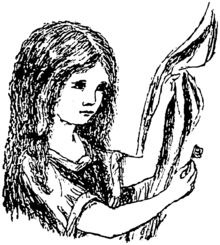
Ane of Carroll'south own illustrations
Literature [edit]
From a immature age, Dodgson wrote poesy and brusque stories, contributing heavily to the family magazine Mischmasch and later on sending them to diverse magazines, enjoying moderate success. Between 1854 and 1856, his work appeared in the national publications The Comic Times and The Train, as well as smaller magazines such as the Whitby Gazette and the Oxford Critic. Nigh of this output was humorous, sometimes satirical, but his standards and ambitions were exacting. "I practice not recollect I take yet written annihilation worthy of existent publication (in which I do not include the Whitby Gazette or the Oxonian Advertiser), but I do not despair of doing so someday," he wrote in July 1855.[26] Sometime after 1850, he did write puppet plays for his siblings' entertainment, of which i has survived: La Guida di Bragia.[36]
In March 1856, he published his get-go slice of work under the proper noun that would make him famous. A romantic poem called "Solitude" appeared in The Train under the authorship of "Lewis Carroll". This pseudonym was a play on his real name: Lewis was the anglicised form of Ludovicus, which was the Latin for Lutwidge, and Carroll an Irish surname similar to the Latin proper noun Carolus, from which comes the name Charles.[6] The transition went as follows: "Charles Lutwidge" translated into Latin as "Carolus Ludovicus". This was and so translated back into English as "Carroll Lewis" and and then reversed to make "Lewis Carroll".[37] This pseudonym was chosen by editor Edmund Yates from a list of iv submitted by Dodgson, the others existence Edgar Cuthwellis, Edgar U. C. Westhill, and Louis Carroll.[38]
Alice books [edit]
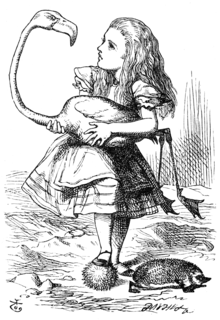
"The chief difficulty Alice found at first was in managing her flamingo". Illustration by John Tenniel, 1865.

The Jabberwock, as illustrated by John Tenniel for Lewis Carroll's Through the Looking-Glass, including the poem "Jabberwocky".
In 1856, Dean Henry Liddell arrived at Christ Church, bringing with him his immature family, all of whom would figure largely in Dodgson's life over the following years, and would greatly influence his writing career. Dodgson became close friends with Liddell's wife Lorina and their children, particularly the three sisters Lorina, Edith, and Alice Liddell. He was widely assumed for many years to take derived his ain "Alice" from Alice Liddell; the acrostic poem at the end of Through the Looking-Drinking glass spells out her proper name in total, and there are besides many superficial references to her hidden in the text of both books. Information technology has been noted that Dodgson himself repeatedly denied in afterwards life that his "little heroine" was based on any existent child,[39] [40] and he frequently defended his works to girls of his acquaintance, adding their names in acrostic poems at the offset of the text. Gertrude Chataway'south name appears in this form at the starting time of The Hunting of the Snark, and it is not suggested that this means that any of the characters in the narrative are based on her.[40]
Information is scarce (Dodgson's diaries for the years 1858–1862 are missing), only it seems articulate that his friendship with the Liddell family unit was an important part of his life in the belatedly 1850s, and he grew into the habit of taking the children on rowing trips (first the boy Harry, and later the three girls) accompanied past an adult friend[41] to nearby Nuneham Courtenay or Godstow.[42]
It was on one such trek on 4 July 1862 that Dodgson invented the outline of the story that eventually became his beginning and greatest commercial success. He told the story to Alice Liddell and she begged him to write information technology downwards, and Dodgson eventually (afterward much filibuster) presented her with a handwritten, illustrated manuscript entitled Alice's Adventures Under Ground in November 1864.[42]
Before this, the family of friend and mentor George MacDonald read Dodgson's incomplete manuscript, and the enthusiasm of the MacDonald children encouraged Dodgson to seek publication. In 1863, he had taken the unfinished manuscript to Macmillan the publisher, who liked information technology immediately. Subsequently the possible alternative titles were rejected – Alice Amidst the Fairies and Alice's Gold Hour – the work was finally published every bit Alice'due south Adventures in Wonderland in 1865 under the Lewis Carroll pen-name, which Dodgson had first used some 9 years before.[28] The illustrations this time were past Sir John Tenniel; Dodgson patently thought that a published volume would need the skills of a professional creative person. Annotated versions provide insights into many of the ideas and hidden meanings that are prevalent in these books.[43] [44] Critical literature has often proposed Freudian interpretations of the book as "a descent into the night world of the subconscious", as well as seeing information technology as a satire upon contemporary mathematical advances.[45] [46]
The overwhelming commercial success of the starting time Alice book changed Dodgson's life in many ways.[47] [48] [49] The fame of his modify ego "Lewis Carroll" soon spread effectually the world. He was inundated with fan mail and with sometimes unwanted attention. Indeed, according to i popular story, Queen Victoria herself enjoyed Alice in Wonderland so much that she allowable that he dedicate his next book to her, and was accordingly presented with his next work, a scholarly mathematical volume entitled An Elementary Treatise on Determinants.[50] [51] Dodgson himself vehemently denied this story, commenting "... It is utterly false in every particular: zero fifty-fifty resembling it has occurred";[51] [52] and it is unlikely for other reasons. As T. B. Strong comments in a Times commodity, "It would have been clean reverse to all his practise to place [the] writer of Alice with the writer of his mathematical works".[53] [54] He also began earning quite substantial sums of coin but continued with his seemingly disliked postal service at Christ Church building.[28]
Late in 1871, he published the sequel Through the Looking-Glass, and What Alice Found There. (The championship page of the showtime edition erroneously gives "1872" as the date of publication.[55]) Its somewhat darker mood possibly reflects changes in Dodgson's life. His father'southward death in 1868 plunged him into a depression that lasted some years.[28]
The Hunting of the Snark [edit]
In 1876, Dodgson produced his adjacent great work, The Hunting of the Snark, a fantastical "nonsense" poem, with illustrations by Henry Holiday, exploring the adventures of a bizarre crew of nine tradesmen and one beaver, who set off to discover the snark. It received largely mixed reviews from Carroll's contemporary reviewers,[56] only was enormously popular with the public, having been reprinted seventeen times betwixt 1876 and 1908,[57] and has seen diverse adaptations into musicals, opera, theatre, plays and music.[58] Painter Dante Gabriel Rossetti reputedly became convinced that the verse form was about him.[28]
Sylvie and Bruno [edit]
In 1895, 30 years subsequently the publication of his masterpieces, Carroll attempted a comeback, producing a two-book tale of the fairy siblings Sylvie and Bruno. Carroll entwines two plots set in two alternative worlds, one set in rural England and the other in the fairytale kingdoms of Elfland, Outland, and others. The fairytale globe satirizes English society, and more specifically the world of academia. Sylvie and Bruno came out in ii volumes and is considered a lesser work, although it has remained in impress for over a century.
Photography (1856–1880) [edit]

In 1856, Dodgson took up the new art form of photography under the influence starting time of his uncle Skeffington Lutwidge, and later of his Oxford friend Reginald Southey.[59] He soon excelled at the art and became a well-known gentleman-photographer, and he seems even to take toyed with the idea of making a living out of it in his very early years.[28]
A study by Roger Taylor and Edward Wakeling exhaustively lists every surviving print, and Taylor calculates that just over one-half of his surviving piece of work depicts young girls, though virtually 60% of his original photographic portfolio is at present missing.[sixty] Dodgson too made many studies of men, women, boys, and landscapes; his subjects as well include skeletons, dolls, dogs, statues, paintings, and copse.[61] His pictures of children were taken with a parent in omnipresence and many of the pictures were taken in the Liddell garden considering natural sunlight was required for adept exposures.[41]
He also found photography to exist a useful entrée into higher social circles.[62] During the virtually productive part of his career, he made portraits of notable sitters such as John Everett Millais, Ellen Terry, Dante Gabriel Rossetti, Julia Margaret Cameron, Michael Faraday, Lord Salisbury, and Alfred Tennyson.[28]
Past the time that Dodgson abruptly ceased photography (1880, over 24 years), he had established his ain studio on the roof of Tom Quad, created around three,000 images, and was an amateur master of the medium, though fewer than i,000 images take survived time and deliberate devastation. He stopped taking photographs considering keeping his studio working was too time-consuming.[63] He used the moisture collodion procedure; commercial photographers who started using the dry-plate process in the 1870s took pictures more quickly.[64] Popular sense of taste changed with the advent of Modernism, affecting the types of photographs that he produced.
Inventions [edit]
To promote letter of the alphabet writing, Dodgson invented "The Wonderland Postage-Postage stamp Case" in 1889. This was a material-backed binder with twelve slots, two marked for inserting the most commonly used penny stamp, and 1 each for the other electric current denominations up to one shilling. The folder was then put into a slipcase busy with a picture show of Alice on the front and the Cheshire True cat on the dorsum. It intended to organize stamps wherever one stored their writing utensils; Carroll expressly notes in Viii or Nine Wise Words nigh Alphabetic character-Writing it is not intended to be carried in a pocket or bag, equally the about common individual stamps could hands be carried on their own. The pack included a copy of a pamphlet version of this lecture.[65] [66]

Reconstructed nyctograph, with scale demonstrated by a 5 euro cent.
Another invention was a writing tablet called the nyctograph that allowed note-taking in the dark, thus eliminating the need to go out of bed and strike a light when one woke with an idea. The device consisted of a gridded card with sixteen squares and a system of symbols representing an alphabet of Dodgson's design, using letter shapes like to the Graffiti writing organisation on a Palm device.[67]
He as well devised a number of games, including an early version of what today is known every bit Scrabble. Devised some fourth dimension in 1878, he invented the "doublet" (see word ladder), a class of brain-teaser that is still popular today, changing ane word into another by altering one letter at a fourth dimension, each successive alter always resulting in a genuine word.[68] For instance, True cat is transformed into DOG past the following steps: CAT, COT, DOT, Canis familiaris.[28] It first appeared in the 29 March 1879 result of Vanity Fair, with Carroll writing a weekly cavalcade for the mag for ii years; the final column dated 9 April 1881.[69] The games and puzzles of Lewis Carroll were the subject of Martin Gardner's March 1960 Mathematical Games column in Scientific American.
Other items include a rule for finding the mean solar day of the calendar week for any appointment; a means for justifying right margins on a typewriter; a steering device for a velociam (a type of tricycle); fairer elimination rules for tennis tournaments; a new sort of postal money gild; rules for reckoning stamp; rules for a win in betting; rules for dividing a number by various divisors; a cardboard scale for the Senior Common Room at Christ Church which, held next to a drinking glass, ensured the right amount of liqueur for the price paid; a double-sided adhesive strip to fasten envelopes or mountain things in books; a device for helping a crippled invalid to read from a book placed sideways; and at least two ciphers for cryptography.[28]
He also proposed alternative systems of parliamentary representation. He proposed the so-chosen Dodgson's method, using the Condorcet method.[70] In 1884, he proposed a proportional representation system based on multi-member districts, each voter casting only a single vote, quotas as minimum requirements to have seats, and votes transferable past candidates through what is now called Liquid commonwealth.[71]
Mathematical work [edit]

Within the academic subject area of mathematics, Dodgson worked primarily in the fields of geometry, linear and matrix algebra, mathematical logic, and recreational mathematics, producing nearly a dozen books under his real proper name. Dodgson also developed new ideas in linear algebra (e.g., the first printed proof of the Kronecker–Capelli theorem),[72] [73] probability, and the report of elections (e.g., Dodgson's method) and committees; some of this piece of work was non published until well after his decease. His occupation as Mathematical Lecturer at Christ Church gave him some financial security.[74]
Mathematical logic [edit]
His work in the field of mathematical logic attracted renewed interest in the tardily 20th century. Martin Gardner's volume on logic machines and diagrams and William Warren Bartley's posthumous publication of the 2nd office of Dodgson's symbolic logic book have sparked a reevaluation of Dodgson's contributions to symbolic logic.[75] [76] [77] Information technology is recognized that in his Symbolic Logic Part II, Dodgson introduced the Method of Trees, the primeval modern use of a truth tree.[78]
Algebra [edit]
Robbins' and Rumsey's investigation[79] of Dodgson condensation, a method of evaluating determinants, led them to the alternating sign matrix conjecture, at present a theorem.
Recreational mathematics [edit]
The discovery in the 1990s of additional ciphers that Dodgson had constructed, in addition to his "Memoria Technica", showed that he had employed sophisticated mathematical ideas in their creation.[lxxx]
Correspondence [edit]
Dodgson wrote and received as many as 98,721 messages, according to a special letter register which he devised. He documented his advice about how to write more satisfying letters in a missive entitled "Eight or Nine Wise Words about Alphabetic character-Writing".[81]
Later years [edit]
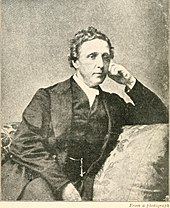
Lewis Carroll in later on life
Dodgson'south beingness remained footling changed over the last twenty years of his life, despite his growing wealth and fame. He continued to teach at Christ Church until 1881 and remained in residence there until his death. Public appearances included attending the West Stop musical Alice in Wonderland (the starting time major live product of his Alice books) at the Prince of Wales Theatre on xxx December 1886.[82] The two volumes of his last novel, Sylvie and Bruno, were published in 1889 and 1893, merely the intricacy of this work was apparently not appreciated by contemporary readers; it accomplished naught like the success of the Alice books, with disappointing reviews and sales of only thirteen,000 copies.[83] [84]
The but known occasion on which he travelled abroad was a trip to Russia in 1867 as an ecclesiastic, together with the Reverend Henry Liddon. He recounts the travel in his "Russian Periodical", which was first commercially published in 1935.[85] On his way to Russian federation and back, he also saw different cities in Belgium, Germany, partitioned Poland, and France.
Decease [edit]
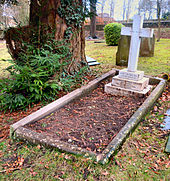
Dodgson died of pneumonia following influenza on 14 January 1898 at his sisters' dwelling, "The Chestnuts", in Guildford in the county of Surrey, just 4 days earlier the expiry of Henry Liddell. He was two weeks away from turning 66 years erstwhile. His funeral was held at the nearby St Mary's Church.[86] His body was buried at the Mountain Cemetery in Guildford.[28]
He is commemorated at All Saints' Church, Daresbury, in its stained drinking glass windows depicting characters from Alice's Adventures in Wonderland.
Controversies and mysteries [edit]
Sexuality [edit]
Some late twentieth-century biographers have suggested that Dodgson'south interest in children had an erotic element, including Morton N. Cohen in his Lewis Carroll: A Biography (1995),[87] Donald Thomas in his Lewis Carroll: A Portrait with Groundwork (1995), and Michael Bakewell in his Lewis Carroll: A Biography (1996). Cohen, in particular, speculates that Dodgson'south "sexual energies sought unconventional outlets", and farther writes:
We cannot know to what extent sexual urges lay behind Charles'south preference for cartoon and photographing children in the nude. He contended the preference was entirely aesthetic. Only given his emotional attachment to children as well as his aesthetic appreciation of their forms, his assertion that his interest was strictly creative is naïve. He probably felt more he dared acknowledge, even to himself.[88]
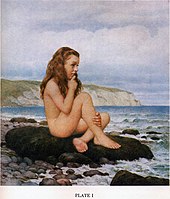
Cohen goes on to note that Dodgson "apparently convinced many of his friends that his attachment to the nude female person child course was gratuitous of any eroticism", merely adds that "later generations look beneath the surface" (p. 229). He argues that Dodgson may accept wanted to marry the 11-twelvemonth-old Alice Liddell and that this was the cause of the unexplained "break" with the family in June 1863,[28] an issue for which other explanations are offered. Biographers Derek Hudson and Roger Lancelyn Greenish terminate short of identifying Dodgson as a paedophile (Greenish besides edited Dodgson's diaries and papers), just they concur that he had a passion for small-scale female children and next to no interest in the developed globe.[ citation needed ] Catherine Robson refers to Carroll as "the Victorian era'southward about famous (or infamous) girl lover".[89]
Several other writers and scholars accept challenged the evidential basis for Cohen'southward and others' views nearly Dodgson's sexual interests. Hugues Lebailly has endeavoured to prepare Dodgson'south child photography inside the "Victorian Child Cult", which perceived child nudity as essentially an expression of innocence.[90] Lebailly claims that studies of kid nudes were mainstream and fashionable in Dodgson's time and that nearly photographers made them equally a matter of course, including Oscar Gustave Rejlander and Julia Margaret Cameron. Lebailly continues that child nudes even appeared on Victorian Christmas cards, implying a very different social and aesthetic cess of such material. Lebailly concludes that it has been an error of Dodgson's biographers to view his child-photography with 20th- or 21st-century eyes, and to take presented it as some form of personal idiosyncrasy, when it was a response to a prevalent artful and philosophical movement of the fourth dimension.
Karoline Leach's reappraisal of Dodgson focused in particular on his controversial sexuality. She argues that the allegations of paedophilia rose initially from a misunderstanding of Victorian morals, as well as the mistaken idea – fostered by Dodgson's various biographers – that he had no interest in developed women. She termed the traditional image of Dodgson "the Carroll Myth". She drew attending to the big amounts of evidence in his diaries and letters that he was also keenly interested in adult women, married and single, and enjoyed several relationships with them that would take been considered scandalous by the social standards of his time. She also pointed to the fact that many of those whom he described as "child-friends" were girls in their tardily teens and even twenties.[91] She argues that suggestions of paedophilia emerged only many years after his death, when his well-meaning family had suppressed all prove of his relationships with women in an effort to preserve his reputation, thus giving a false impression of a man interested only in little girls. Similarly, Leach points to a 1932 biography past Langford Reed every bit the source of the dubious claim that many of Carroll'southward female person friendships ended when the girls reached the age of 14.[92]
In add-on to the biographical works that have discussed Dodgson'south sexuality, in that location are modern artistic interpretations of his life and work that do so also – in particular, Dennis Potter in his play Alice and his screenplay for the motion motion-picture show Dreamchild, and Robert Wilson in his musical Alice.
Ordination [edit]
Dodgson had been clean-cut for the ordained ministry building in the Church of England from a very early on age and was expected to be ordained within four years of obtaining his primary'due south degree, as a condition of his residency at Christ Church. He delayed the process for some time just was somewhen ordained as a deacon on 22 December 1861. But when the time came a twelvemonth subsequently to be ordained as a priest, Dodgson appealed to the dean for permission not to proceed. This was confronting college rules and, initially, Dean Liddell told him that he would accept to consult the college ruling body, which would near certainly have resulted in his beingness expelled. For unknown reasons, Liddell changed his listen overnight and permitted him to remain at the college in defiance of the rules.[93] Dodgson never became a priest, unique amid senior students of his time.
There is currently no conclusive bear witness near why Dodgson rejected the priesthood. Some have suggested that his stammer made him reluctant to take the step because he was afraid of having to preach.[94] Wilson quotes letters by Dodgson describing difficulty in reading lessons and prayers rather than preaching in his own words.[95] But Dodgson did indeed preach in subsequently life, even though non in priest's orders, so information technology seems unlikely that his impediment was a major factor affecting his choice.[ commendation needed ] Wilson as well points out that the Bishop of Oxford, Samuel Wilberforce, who ordained Dodgson, had strong views confronting clergy going to the theatre, ane of Dodgson's great interests. He was interested in minority forms of Christianity (he was an gentleman of F. D. Maurice) and "alternative" religions (theosophy).[96] Dodgson became deeply troubled by an unexplained sense of sin and guilt at this time (the early 1860s) and frequently expressed the view in his diaries that he was a "vile and worthless" sinner, unworthy of the priesthood and this sense of sin and unworthiness may well have affected his decision to carelessness being ordained to the priesthood.[97]
Missing diaries [edit]
At least four complete volumes and effectually seven pages of text are missing from Dodgson'south thirteen diaries.[98] The loss of the volumes remains unexplained; the pages have been removed by an unknown manus. Most scholars assume that the diary material was removed by family members in the interests of preserving the family name, but this has not been proven.[99] Except for 1 page, fabric is missing from his diaries for the period between 1853 and 1863 (when Dodgson was 21–31 years old).[100] [101] [ failed verification ] During this period , Dodgson began experiencing cracking mental and spiritual anguish and confessing to an overwhelming sense of his ain sin. This was as well the catamenia of time when he composed his extensive love poetry, leading to speculation that the poems may have been autobiographical.[102] [103]
Many theories take been put forward to explicate the missing textile. A pop explanation for one missing folio (27 June 1863) is that information technology might have been torn out to conceal a proposal of marriage on that solar day by Dodgson to the 11-yr-old Alice Liddell. However, there has never been whatever testify to suggest that this was so, and a paper offers some evidence to the contrary which was discovered by Karoline Leach in the Dodgson family annal in 1996.[104]
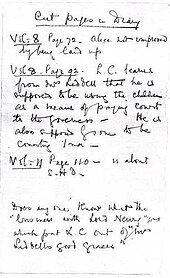
The "cut pages in diary" document, in the Dodgson family archive in Woking
This newspaper is known as the "cutting pages in diary" document, and was compiled by various members of Carroll's family after his death. Role of it may have been written at the time when the pages were destroyed, though this is unclear. The document offers a brief summary of two diary pages that are missing, including the ane for 27 June 1863. The summary for this folio states that Mrs. Liddell told Dodgson that at that place was gossip circulating well-nigh him and the Liddell family'southward governess, as well as about his human relationship with "Ina", presumably Alice's older sister Lorina Liddell. The "break" with the Liddell family unit that occurred before long after was presumably in response to this gossip.[105] [106] An alternative interpretation has been made[ by whom? ] regarding Carroll'southward rumoured interest with "Ina": Lorina was also the proper noun of Alice Liddell'due south mother. What is deemed most crucial and surprising is that the document seems to imply that Dodgson's break with the family was non connected with Alice at all; until a primary source is discovered, the events of 27 June 1863 will remain in doubt.
Migraine and epilepsy [edit]
In his diary for 1880, Dodgson recorded experiencing his first episode of migraine with aureola, describing very accurately the process of "moving fortifications" that are a manifestation of the aura stage of the syndrome.[107] Unfortunately, at that place is no clear evidence to bear witness whether this was his first experience of migraine per se, or if he may have previously had the far more common form of migraine without aura, although the latter seems most probable, given the fact that migraine near usually develops in the teens or early on adulthood. Some other class of migraine aura chosen Alice in Wonderland syndrome has been named after Dodgson's little heroine considering its manifestation can resemble the sudden size-changes in the volume. Information technology is also known as micropsia and macropsia, a brain condition affecting the way that objects are perceived by the mind. For example, an afflicted person may await at a larger object such as a basketball game and perceive it as if it were the size of a golf ball. Some authors have suggested that Dodgson may accept experienced this type of aura and used information technology every bit an inspiration in his work, but there is no bear witness that he did.[108] [109]
Dodgson likewise had ii attacks in which he lost consciousness. He was diagnosed past a Dr. Morshead, Dr. Brooks, and Dr. Stedman, and they believed the attack and a consequent attack to exist an "epileptiform" seizure (initially thought to be fainting, but Brooks changed his mind). Some have ended from this that he had this condition for his unabridged life, merely there is no evidence of this in his diaries beyond the diagnosis of the two attacks already mentioned.[107] Some authors, Sadi Ranson in particular, have suggested that Carroll may have had temporal lobe epilepsy in which consciousness is not always completely lost but altered, and in which the symptoms mimic many of the same experiences as Alice in Wonderland. Carroll had at least i incident in which he suffered full loss of consciousness and awoke with a bloody olfactory organ, which he recorded in his diary and noted that the episode left him non feeling himself for "quite one-time later on". This assail was diagnosed as possibly "epileptiform" and Carroll himself later wrote of his "seizures" in the same diary.
Nigh of the standard diagnostic tests of today were not bachelor in the nineteenth century. Yvonne Hart, consultant neurologist at the John Radcliffe Hospital, Oxford, considered Dodgson'southward symptoms. Her conclusion, quoted in Jenny Woolf's 2010 The Mystery of Lewis Carroll, is that Dodgson very likely had migraine and may have had epilepsy, simply she emphasises that she would accept considerable doubt most making a diagnosis of epilepsy without farther data.[110]
Legacy [edit]

There are societies in many parts of the world defended to the enjoyment and promotion of his works and the investigation of his life.[111]
Copenhagen Street in Islington, north London is the location of the Lewis Carroll Children's Library.[112]
In 1982, his neat-nephew unveiled a memorial rock to him in Poets' Corner, Westminster Abbey.[113] In January 1994, an asteroid, 6984 Lewiscarroll, was discovered and named after Carroll. The Lewis Carroll Centenary Forest near his birthplace in Daresbury opened in 2000.[114]
Born in All Saints' Vicarage, Daresbury, Cheshire, in 1832, Lewis Carroll is commemorated at All Saints' Church, Daresbury in its stained glass windows depicting characters from Alice's Adventures in Wonderland. In March 2012, the Lewis Carroll Centre, attached to the church, was opened.[115]
Works [edit]
Literary works [edit]
- La Guida di Bragia, a Ballad Opera for the Marionette Theatre (effectually 1850)
- "Miss Jones", comic song (1862)[116]
- Alice's Adventures in Wonderland (1865)
- Phantasmagoria and Other Poems (1869)
- Through the Looking-Glass, and What Alice Found There (includes "Jabberwocky" and "The Walrus and the Carpenter") (1871)
- The Hunting of the Snark (1876)
- Rhyme? And Reason? (1883) – shares some contents with the 1869 collection, including the long verse form "Phantasmagoria"
- A Tangled Tale (1885)
- Sylvie and Bruno (1889)
- The Nursery "Alice" (1890)
- Sylvie and Bruno Concluded (1893)
- Pillow Problems (1893)
- What the Tortoise Said to Achilles (1895)
- Iii Sunsets and Other Poems (1898)
- The Manlet (1903)[117]
Mathematical works [edit]
- A Syllabus of Plane Algebraic Geometry (1860)
- The Fifth Book of Euclid Treated Algebraically (1858 and 1868)
- An Elementary Treatise on Determinants, With Their Application to Simultaneous Linear Equations and Algebraic Equations
- Euclid and his Modernistic Rivals (1879), both literary and mathematical in way
- Symbolic Logic Part I
- Symbolic Logic Part Two (published posthumously)
- The Alphabet Cipher (1868)
- The Game of Logic (1887)
- Curiosa Mathematica I (1888)
- Curiosa Mathematica II (1892)
- A discussion of the various methods of procedure in conducting elections (1873), Suggestions as to the best method of taking votes, where more than ii problems are to be voted on (1874), A method of taking votes on more than two issues (1876), collected as The Theory of Committees and Elections, edited, analysed, and published in 1958 by Duncan Black
Other works [edit]
- Some Pop Fallacies about Vivisection
- Eight or Nine Wise Words About Letter of the alphabet-Writing
- Notes by an Oxford Chiel
- The Principles of Parliamentary Representation (1884)
Come across as well [edit]
- Lewis Carroll identity
- Lewis Carroll Shelf Award
- RGS Worcester and The Alice Ottley School – Miss Ottley, the first Headmistress of The Alice Ottley Schoolhouse, was a friend of Lewis Carroll. One of the school'due south houses was named after him.
- Carroll diagram
- Origins of a Story
- The White Knight
References [edit]
- ^ "Lewis Carroll Societies". Lewiscarrollsociety.org.united kingdom. Archived from the original on 29 March 2016. Retrieved 7 Oct 2020.
- ^ Lewis Carroll Order of N America Inc. Archived 26 March 2022 at the Wayback Machine Charity Navigator. Retrieved 7 Oct
- ^ Clark, p. 10
- ^ Collingwood, pp. 6–vii
- ^ Collingwood, p. viii
- ^ a b Cohen, pp. 30–35
- ^ "Google map of Daresbury, UK". Archived from the original on 26 March 2022. Retrieved 22 October 2011.
- ^ "Charles Lutwidge Dodgson". The MacTutor History of Mathematics annal. Archived from the original on 5 July 2011. Retrieved viii March 2011.
- ^ Cohen, pp. 200–202
- ^ Cohen, p. 4
- ^ Collingwood, pp. 30–31
- ^ a b Woolf, Jenny (2010). The Mystery of Lewis Carroll: Discovering the Whimsical, Thoughtful, and Sometimes Lonely Man Who Created "Alice in Wonderland". New York: St. Martin'south Press. pp. 24. ISBN9780312612986.
- ^ Collingwood, p. 29
- ^ Carroll, Lewis (1995). Wakeling, Edward (ed.). Rediscovered Lewis Carroll Puzzles. New York Metropolis: Dover Publications. pp. xiii. ISBN0486288617.
- ^ Lovett, Charlie (2005). Lewis Carroll Among His Books: A Descriptive Catalogue of the Private Library of Charles L. Dodgson. Jefferson, Northward Carolina: McFarland & Company, Inc., Publishers. p. 329. ISBN0786421053.
- ^ Clark, pp. 63–64
- ^ a b Clark, pp. 64–65
- ^ Collingwood, p. 52
- ^ Clark, p. 74
- ^ Collingwood, p. 57
- ^ Wilson, p. 51
- ^ Cohen, p. 51
- ^ Clark, p. 79
- ^ Overflowing, Raymond; Rice, Adrian; Wilson, Robin (2011). Mathematics in Victorian Britain. Oxfordshire, England: Oxford Academy Printing. p. 41. ISBN978-0-19-960139-4. OCLC 721931689.
- ^ Cohen, pp. 414–416
- ^ a b c d eastward f Leach, Ch. 2.
- ^ Leach, p. 91
- ^ a b c d e f g h i j one thousand Cohen, pp. 100–four
- ^ Gardner, Martin (2000). Introduction to The annotated Alice: Alice'south adventures in Wonderland & Through the looking glass. W. W. Norton & Company. p. xv. ISBN0-517-02962-half-dozen.
- ^ Gardner, Martin (2009). Introduction to Alice'southward Adventures in Wonderland and Through the Looking-Glass. Oxford University Press. p. xvi. ISBN978-0-517-02962-half dozen.
- ^ Collingwood
- ^ Collingwood, Chapter Nine
- ^ Hayness, Renée (1982). The Guild for Psychical Inquiry, 1882–1982 A History. London: Macdonald & Co. pp. 13–14. ISBN0-356-07875-2.
- ^ Carroll, 50. (1895). "What the Tortoise Said to Achilles". Mind. IV (14): 278–280. doi:x.1093/heed/IV.fourteen.278.
- ^ Blackburn, South. (1995). "Practical Tortoise Raising". Heed. 104 (416): 695–711. doi:10.1093/mind/104.416.695.
- ^ Heath, Peter L. (2007). "Introduction". La Guida Di Bragia, a Carol Opera for the Marionette Theatre. Lewis Carroll Society of North America. pp. vii–sixteen. ISBN978-0-930326-15-9.
- ^ Roger Lancelyn Green On-line Encyclopædia Britannica Archived nine May 2015 at the Wayback Machine
- ^ Thomas, p. 129
- ^ Cohen, Morton N. (ed) (1979) The Messages of Lewis Carroll, London: Macmillan.
- ^ a b Leach, Ch. 5 "The Unreal Alice"
- ^ a b Winchester, Simon (2011). The Alice Backside Wonderland . Oxford University Press. ISBN978-0-nineteen-539619-5. OCLC 641525313.
- ^ a b Leach, Ch. four
- ^ Gardner, Martin (2000). "The Annotated Alice. The Definitive Edition". New York: W.Westward. Norton.
- ^ Heath, Peter (1974). "The Philosopher'due south Alice". New York: St. Martin's Printing.
- ^ "Algebra in Wonderland". The New York Times. 7 March 2010. Archived from the original on 12 March 2010. Retrieved 10 February 2017.
- ^ Bayley, Melanie. "Alice's adventures in algebra: Wonderland solved". New Scientist. Archived from the original on 25 January 2022. Retrieved 14 October 2016.
- ^ Elster, Charles Harrington (2006). The big volume of beastly mispronunciations: the consummate opinionated guide for the careful speaker. Houghton Mifflin Harcourt. pp. 158–159. ISBN061842315X. Archived from the original on three January 2017. Retrieved 3 August 2016.
- ^ Emerson, R. H. (1996). "The Unpronounceables: Hard Literary Names 1500–1940". English language Notes. 34 (2): 63–74. ISSN 0013-8282.
- ^ "Lewis Carroll". Biography in Context. Gale. Archived from the original on 26 March 2022. Retrieved 24 September 2015.
- ^ Wilson
- ^ a b "Lewis Carroll – Logician, Nonsense Author, Mathematician and Lensman". The Hitchhiker's Guide to the Galaxy. BBC. 26 August 2005. Archived from the original on three February 2009. Retrieved 12 February 2009.
- ^ Dodgson, Charles (1896). Symbolic Logic.
- ^ Strong, T. B. (27 January 1932). "Mr. Dodgson: Lewis Carroll at Oxford". [The Times].
- ^ "Fit for a Queen". Snopes. Archived from the original on 26 March 2022. Retrieved 25 March 2011.
- ^ Cohen, Morton (24 June 2009). Introduction to "Alice in Wonderland and Through the Looking-Glass". Random House. ISBN978-0-553-21345-4.
- ^ Cohen, Morton Due north. (1976). "Hark the Snark". In Guilano, Edward (ed.). Lewis Carroll Observed. New York: Clarkson N. Potter, Inc. pp. 92–110. ISBN0-517-52497-Ten.
- ^ Williams, Sidney Herbert; Madan, Falconer (1979). Handbook of the literature of the Rev. C.L. Dodgson. Folkestone, England: Dawson. p. 68. ISBN9780712909068. OCLC 5754676.
- ^ Greenarce, Selwyn (2006) [1876]. "The Listing of the Snark". In Martin Gardner (ed.). The Annotated Hunting of the Snark (Definitive ed.). W. W. Norton. pp. 117–147. ISBN0-393-06242-2.
- ^ Clark, p. 93
- ^ Taylor, Roger; Wakeling, Edward (25 February 2002). Lewis Carroll, Photographer. Princeton Academy Printing. ISBN978-0-691-07443-vi.
- ^ Cohen, Morton (1999). "Reflections in a Looking Glass." New York: Aperture.
- ^ Thomas, p. 116
- ^ Thomas, p. 265
- ^ Wakeling, Edward (1998). "Lewis Carroll'due south Photography". An Exhibition From the Jon A. Lindseth Collection of C. 50. Dodgson and Lewis Carroll. New York, NY: The Grolier Club. pp. 55–67. ISBN0-910672-23-7.
- ^ Flodden W. Heron, "Lewis Carroll, Inventor of Stamp Instance" in Stamps, vol. 26, no. 12, 25 March 1939
- ^ "Carroll Related Stamps". The Lewis Carroll Lodge. 28 Apr 2005. Archived from the original on 27 Feb 2012. Retrieved 10 March 2011.
- ^ Everson, Michael. (2011) "Alice'south Adventures in Wonderland: An edition printed in the Nyctographic Foursquare Alphabet devised past Lewis Carroll". Foreword by Alan Tannenbaum, Éire: Cathair na Mart. ISBN 978-1-904808-78-7
- ^ Gardner, Martin. "Word Ladders: Lewis Carroll's Doublets". No. Vol. 80, No. 487, Centenary Issue (Mar., 1996). The Mathematical Gazette. Archived from the original on 20 April 2021. Retrieved 22 March 2022.
- ^ Deanna Haunsperger, Stephen Kennedy (31 July 2006). The Edge of the Universe: Celebrating Ten Years of Math Horizons. Mathematical Association of America. p. 22. ISBN0-88385-555-0.
- ^ Black, Duncan; McLean, Iain; McMillan, Alistair; Monroe, Burt L.; Dodgson, Charles Lutwidge (1996). A Mathematical Approach to Proportional Representation. ISBN978-0-7923-9620-eight. Archived from the original on four February 2021. Retrieved 4 Oct 2020.
- ^ Charles Dodgson, Principles of Parliamentary Representation (1884)
- ^ Seneta, Eugene (1984). "Lewis Carroll as a Probabilist and Mathematician" (PDF). The Mathematical Scientist. ix: 79–84. Archived (PDF) from the original on 30 Jan 2016. Retrieved one February 2015.
- ^ Abeles, Francine F. (1998) Charles L. Dodgson, Mathematician". An Exhibition From the Jon A. Lindseth Drove of C.L. Dodgson and Lewis Carroll". New York:The Grolier Club, pp. 45–54.
- ^ Wilson, p. 61
- ^ Gardner, Martin. (1958) "Logic Machines and Diagrams". Brighton, Sussex:Harvester Printing
- ^ Bartley, William Warren Iii, ed. (1977) "Lewis Carroll's Symbolic Logic". New York: Clarkson N. Potter, 2d ed 1986.
- ^ Moktefi, Amirouche. (2008) "Lewis Carroll'southward Logic", pp. 457–505 in British Logic in the Nineteenth Century, Vol. four of Handbook of the History of Logic, Dov M. Gabbay and John Woods (eds.) Amsterdam: Elsevier.
- ^ "Modern Logic: The Boolean Period: Carroll – Encyclopedia.com". Archived from the original on 3 August 2020. Retrieved 22 July 2020.
- ^ Robbins, D. P.; Rumsey, H. (1986). "Determinants and alternating sign matrices". Advances in Mathematics. 62 (2): 169. doi:x.1016/0001-8708(86)90099-10.
- ^ Abeles, F. F. (2005). "Lewis Carroll's ciphers: The literary connections". Advances in Applied Mathematics. 34 (4): 697–708. doi:10.1016/j.aam.2004.06.006.
- ^ Clark, Dorothy G. (April 2010). "The Place of Lewis Carroll in Children'due south Literature (review)". The King of beasts and the Unicorn. 34 (ii): 253–258. doi:10.1353/uni.0.0495. S2CID 143924225. Archived from the original on 4 March 2016. Retrieved 21 January 2014.
- ^ Carroll, Lewis (1979). The Messages of Lewis Carroll, Volumes 1-2. Oxford University Press. p. 657.
Dec. 30th.—To London with 1000—, and took her to "Alice in Wonderland," Mr. Savile Clarke's play at the Prince of Wales's Theatre... as a whole, the play seems a success.
- ^ Angelica Shirley Carpenter (2002). Lewis Carroll: Through the Looking Drinking glass. Lerner. p. 98.ISBN 978-0822500735.
- ^ Christensen, Thomas (1991). "Dodgson'due south Dodges" Archived 15 July 2011 at the Wayback Machine. rightreading.com.
- ^ "Chronology of Works of Lewis Carroll". Archived from the original on 20 February 2009. Retrieved 20 February 2009.
- ^ "Lewis Carroll and St Mary's Church – Guildford: This Is Our Town website". Archived from the original on 11 November 2016. Retrieved x November 2016.
- ^ Cohen, pp. 166–167, 254–255
- ^ Cohen, p. 228
- ^ Robson, Catherine (2001). Men in Wonderland: The Lost Girlhood of the Victorian Gentlemen. Princeton, New Bailiwick of jersey: Princeton University Press. p. 137. ISBN978-0691004228.
- ^ "Clan for new Lewis Carroll studies". Contrariwise.wild-reality.net. Archived from the original on vii February 2012. Retrieved 19 October 2019.
- ^ Leach, pp. 16–17
- ^ Leach, p. 33
- ^ Dodgson's MS diaries, volume 8, 22–24 Oct 1862
- ^ Cohen, p. 263
- ^ Wilson, pp. 103–104
- ^ Leach, p. 134
- ^ Dodgson's MS diaries, book eight, run across prayers scattered throughout the text
- ^ Leach, pp. 48, 51
- ^ Leach, pp. 48–51
- ^ Leach, p. 52
- ^ Wakeling, Edward (April 2003). "The Real Lewis Carroll / A Talk given to the Lewis Carroll Society". 1855 ... 1856 ... 1857 ... 1858 ... 1862 ... 1863. Archived from the original on 22 Baronial 2016. Retrieved xiv September 2009.
- ^ Leach p. 54
- ^ "The Dodgson Family and Their Legacy". Archived from the original on fourteen Jan 2011. Retrieved 5 January 2011.
- ^ Dodgson Family Drove, Cat. No. F/17/1. "Cutting Pages in Diary". (For an account of its discovery see The Times Literary Supplement, 3 May 1996.)
- ^ Leach, pp. 170–2.
- ^ "Text available on-line". Looking for Lewis Carroll. Archived from the original on 16 Nov 2018. Retrieved iv May 2007.
- ^ a b Wakeling, Edward (Ed.) "The Diaries of Lewis Carroll", Vol. 9, p. 52
- ^ Maudie, F.Due west. "Migraine and Lewis Carroll". The Migraine Periodical. 17.
- ^ Podoll, Thou; Robinson, D (1999). "Lewis Carroll'southward migraine experiences". The Lancet. 353 (9161): 1366. doi:10.1016/S0140-6736(05)74368-three. PMID 10218566. S2CID 5082284.
- ^ Woolf, Jenny (4 Feb 2010). The Mystery of Lewis Carroll. St. Martin's Press. pp. 298–nine. ISBN978-0-312-67371-0.
- ^ "Lewis Carroll Societies". Lewiscarrollsociety.org.u.k.. Archived from the original on 29 March 2016. Retrieved 12 September 2013.
- ^ "'A well-nigh curious thing' / Lewis Carroll Library". www.designbybeam.com. Archived from the original on 3 April 2015. Retrieved 15 March 2013.
- ^ "LEWIS CARROLL IS HONORED ON 150TH Birthday". The New York Times. 18 December 1982. Archived from the original on 5 May 2015. Retrieved thirty January 2015.
- ^ "Lewis Carroll Centenary Wood most Daresbury Runcorn". www.woodlandtrust.org.uk. Archived from the original on 5 August 2020. Retrieved 27 Nov 2019.
- ^ About Us, Lewis Carroll Centre & All Saints Daresbury PCC, archived from the original on xiv April 2012, retrieved 11 April 2012
- ^ The Carrollian. Lewis Carroll Lodge. Effect 7–8. p. 7. 2001: "In 1862 when Lewis Carroll sent to Yates the manuscript of the words of a 'melancholy song', entitled 'Miss Jones', he hoped that it would exist published and performed by a comedian on a London music-hall stage." Archived iv August 2020 at the Wayback Auto
- ^ The Hunting of the Snark and Other Poems and Verses, New York: Harper & Brothers, 1903
Bibliography [edit]
- Clark, Ann (1979). Lewis Carroll: A Biography. London: J. M. Dent. ISBN0-460-04302-1.
- Cohen, Morton (1996). Lewis Carroll: A Biography. Vintage Books. pp. 30–35. ISBN0-679-74562-9.
- Collingwood, Stuart Dodgson (1898). The Life and Letters of Lewis Carroll. London: T. Fisher Unwin.
- Leach, Karoline (1999). In the Shadow of the Dreamchild: A New Understanding of Lewis Carroll. London: Peter Owen.
- Pizzati, Giovanni: "An Endless Procession of People in Masquerade". Figure piane in Alice in Wonderland. 1993, Cagliari.
- Reed, Langford: The Life of Lewis Carroll (1932. London: Due west. and G. Foyle)
- Taylor, Alexander L., Knight: The White Knight (1952. Edinburgh: Oliver and Boyd)
- Taylor, Roger & Wakeling, Edward: Lewis Carroll, Photographer. 2002. Princeton University Press. ISBN 0-691-07443-7. (Catalogues nearly every Carroll photograph known to exist all the same in being.)
- Thomas, Donald (1996). Lewis Carroll: A Biography. Barnes and Noble, Inc. ISBN978-0-7607-1232-0.
- Wilson, Robin (2008). Lewis Carroll in Numberland: His Fantastical Mathematical Logical Life. London: Allen Lane. ISBN978-0-7139-9757-6.
- Woolf, Jenny: The Mystery of Lewis Carroll. 2010. New York: St Martin's Press. ISBN 978-0-312-61298-vi
Further reading [edit]
- Black, Duncan (1958). The Circumstances in which Rev. C. Fifty. Dodgson (Lewis Carroll) wrote his Three Pamphlets and Appendix: Text of Dodgson'southward Three Pamphlets and of 'The Cyclostyled Sheet' in The Theory of Committees and Elections, Cambridge: Cambridge University Printing
- Bowman, Isa (1899). The Story of Lewis Carroll: Told for Immature People by the Real Alice in Wonderland, Miss Isa Bowman. London: J.One thousand. Dent & Co.
- Carroll, Lewis: The Annotated Alice: 150th Anniversary Deluxe Edition. Illustrated by John Tenniel. Edited by Martin Gardner & Mark Burstein. W. W. Norton. 2015. ISBN 978-0-393-24543-1
- Dodgson, Charles L.: Euclid and His Mod Rivals. Macmillan. 1879.
-
Dodgson, Charles Fifty.: The Pamphlets of Lewis Carroll- Vol. 1: The Oxford Pamphlets. 1993. ISBN 0-8139-1250-4
- Vol. two: The Mathematical Pamphlets. 1994. ISBN 0-9303-26-09-1
- Vol. three: The Political Pamphlets. 2001. ISBN 0-930326-14-viii
- Vol. iv: The Logic Pamphlets. 2010 ISBN 978-0-930326-25-8.
- Douglas-Fairhurst, Robert (2016). The Story of Alice: Lewis Carroll and the Secret History of Wonderland. Harvard University Press. ISBN 9780674970762.
- Goodacre, Selwyn (2006). All the Snarks: The Illustrated Editions of the Hunting of the Snark. Oxford: Inky Parrot Printing.
- Graham-Smith, Darien (2005). Contextualising Carroll, University of Wales, Bangor. PhD thesis.
- Huxley, Francis: The Raven and the Writing Desk. 1976. ISBN 0-06-012113-0.
- Kelly, Richard: Lewis Carroll. 1990. Boston: Twayne Publishers.
- Kelly, Richard (ed.): Alice's Adventures in Wonderland. 2000. Peterborough, Ontario: Broadviewpress.
- Lovett, Charlie: Lewis Carroll Amid His Books: A Descriptive Catalogue of the Private Library of Charles Fifty. Dodgson. 2005. ISBN 0-7864-2105-3
- Waggoner, Diane (2020). Lewis Carroll'south Photography and Mod Childhood. Princeton: Princeton University Printing. ISBN978-0-691-19318-2.
- Wakeling, Edward (2015). The Photographs of Lewis Carroll: A Catalogue Raisonné. Austin: University of Texas Press. ISBN978-0-292-76743-0.
- Wullschläger, Jackie: Inventing Wonderland. ISBN 0-7432-2892-8. — Also looks at Edward Lear (of the "nonsense" verses), J. Grand. Barrie (Peter Pan), Kenneth Grahame (The Current of air in the Willows), and A. A. Milne (Winnie-the-Pooh).
- N.Northward.: Dreaming in Pictures: The Photography of Lewis Carroll. Yale Academy Press & SFMOMA, 2004. (Places Carroll firmly in the fine art photography tradition.)
External links [edit]
- Digital collections
- Works by Lewis Carroll in eBook form at Standard Ebooks
- Works by Lewis Carroll at Project Gutenberg
- Works by or well-nigh Lewis Carroll at Internet Archive
- Works by Lewis Carroll at LibriVox (public domain audiobooks)

- Works past Lewis Carroll at Open Library
- The Poems of Lewis Carroll
- [1] Offset Editions
- Physical collections
- Guide to Harcourt Amory drove of Lewis Carroll at Houghton Library, Harvard University
- Lewis Carroll at the British Library
- Lewis Carroll online exhibition at the Harry Ransom Center at the University of Texas at Austin
- Lewis Carroll Scrapbook Drove at the Library of Congress
- "Archival material relating to Lewis Carroll". UK National Archives.

- Biographical data and scholarship
- Lewis Carroll at victorianweb.org
- Contrariwise: the Clan for New Lewis Carroll Studies — articles by leading members of the 'new scholarship'
- Lewis Carroll's Shifting Reputation
- Other links
- Lewis Carroll at the Internet Book List
- Lewis Carroll at the Net Speculative Fiction Database
- Paper clippings virtually Lewis Carroll in the 20th Century Press Archives of the ZBW
- The Lewis Carroll Society
Source: https://en.wikipedia.org/wiki/Carrollian
0 Response to "Engraving 1888 a Corner in Westminster Abbey Art Supplement to the Churchman"
Post a Comment